






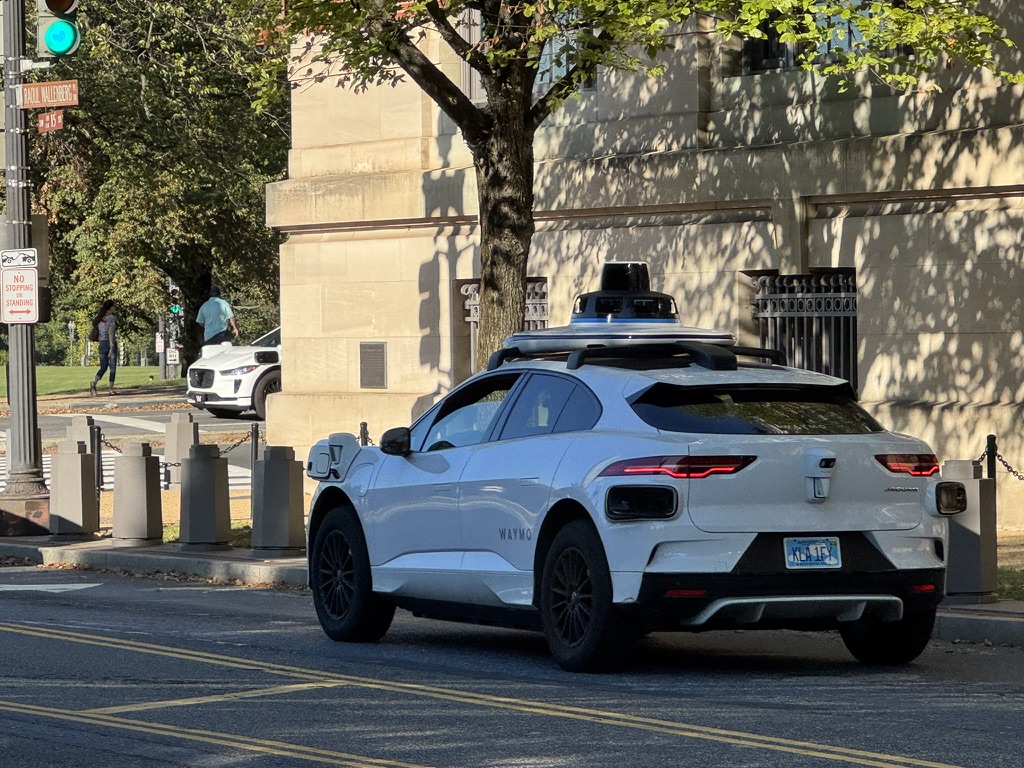
London’s streets are poised for the biggest mobility shift this century. Following a key announcement from the UK government and Waymo last week, self-driving vehicles (also called autonomous vehicles or AVs) are officially slated for introduction as a transport service to the capital by Spring 2026, adding to London’s urban transport mix.
The announcement has been largely positively received, including by disability and road safety groups. Most see this as an opportunity to address human error issues that factor into +90% of collisions, age and ability-related discrimination such as drivers illegally rejecting service animals, and ongoing significant urban transport access barriers.
The general secretary of the Licensed Taxi Drivers Association called driverless vehicles “a gimmick” and wondered who would trust putting themselves or their kids in one. At the same time safety data from at scale use in US cities shows that self-driving vehicles have fewer crashes and potentially have a traffic calming effect, positively influencing human drivers.
We see that this is much more than a story about novel technologies, it’s a human opportunity.
Leading disability and road safety groups like the RNIB, Motability Operations, RoadSafe, and RoSPA have actively welcomed the initiative along with several disabled leaders. They view AVs not as a novelty, but as a potential solution to close the profound safety and accessibility gaps currently embedded in our urban transport ecosystem.
The lovely Robin Spinks, from RNIB shared his experience of being in a Waymo in Atlanta recently. The excitement at being able to travel truly independently is palpable in the video.
Why Self-Driving Taxis Matter?
The impacts (positive or negative) of new innovations such as self-driving vehicles, depend on who you are listening to and the breadth of needs understood and centered by regulators and solution providers like Waymo.
At Open, having worked for the past decade listening to and understanding the transport experiences of disabled and older individuals across a wide range of public and private transport modes, personal needs and contexts, we are excited by the introduction of AVs into the urban transport mix.
There are substantial gaps in today’s public and private transport systems that are restricting disabled and older people from taking the journeys they want, or taking journeys that are cost and time efficient and safe.
Self-driving transport solutions could more efficiently and safely close some of these unmet transport needs.
Today’s Reality – The Transport Gap
Today’s public and private transport systems have significant limitations that impose substantial, costly barriers on millions of Londoners and visitors, particularly those with disabilities, age-related, temporary or situational access needs.
This isn’t just an inconvenience; it restricts full social and economic participation for more than one in four people.
- Fewer trips: disabled people take on average 38% fewer trips than those without disabilities
- Independence: 30% of disabled people say difficulties with public transport has reduced their independence
- Exclusion: 1 in 5 disabled people are unable to travel due to the lack of an appropriate option
- Safety: Disabled people are more than 4 times more likely to be injured as a pedestrian than non-disabled people
- Time cost: Journeys requiring step-free access can take up to 5 times longer for wheelchair users than non-disabled people in London. Only a third of London’s underground stations and just over half the overground stations have step-free access. This is progressing, with new infrastructure like the Elizabeth Line and improvements to older stations, but very slowly.
- Human failure: Through our research we have listened to many disabled people sharing their transport experiences including taxi drivers illegally refusing to allow people with service animals into their vehicle, ticket staff refusing to recognise Disabled Person’s Railcards when someone has a non-visible disability and illegally fining them for having a discounted fare, bus drivers driving past wheelchair users at a stop to save time and assistance staff failing to turn up with a ramp as required to let people on/off trains at their station. People without disabilities also park in designated disabled people’s carparks and across curb cuts required by those with disabilities.
An Opportunity for Progress
AVs will provide a new option into the mix of London transport that could offer people greater confidence, safety and ease as they move about the capital. This is particularly true for those most excluded today. We see potential benefits for those with a wide range of access needs including those who are blind or low vision, are wheelchair or mobility scooter users, those with non-apparent disabilities such as memory, sensory or spatial navigation challenges or temporary needs such as someone using crutches after breaking their leg (me last year!).
Most collisions today happen due to human error. Self-driving cars don’t forget to look before turning, drink and drive, glance at their phone, speed or go through orange (or red) lights. They also are coded to respect safe distance guidance between the vehicle and pedestrians or other vehicles around them. Yet as a relatively new technology and mobility solution the regulatory framework, product and service designs need to ensure that what they are coded to do considers and is well designed for all users of roads.
The good news is that computers tend to consistently do what they are asked to do. This is a limitation also. They need to be asked with the right set of understanding coded in. Coding, development and testing of the technologies in practice needs to be informed with considerations built in that account for the diversity of people impacted – including how people may move, sense, think, feel or communicate in atypical or non-normative ways due to disability or any other factor.
We need to ensure such solutions are designed to work safely across the full potential range of passengers, weather and road contexts and external to the vehicle elements. These include a diverse spectrum of pedestrians, people using other travel alternatives including mobility devices, scooters, bicycles etc. in a range of ways, stationary objects such as curb cuts or pedestrian crossings, and other vehicles.
Broader perspectives. Better solutions.
We have promising signs that the government and service providers are proactively listening to and seeking to understand groups that are often overlooked and under-heard, regarding the introduction of AVs. This includes disabled and older individuals, women (especially considering transport safety) and those from other underserved and often under-considered backgrounds. Events, such as the roundtable held at the Labour Party Conference in Liverpool a few weeks ago, are a good start.
This listening needs to continue on an ongoing basis and be effectively translated into the key design areas that will determine the service’s success or failure, including:
- Regulations and guidelines: Ensuring understanding and meeting inclusive needs are the foundational requirements, not an afterthought. This includes the initial requirements for market entry as well as ongoing policy progress as knowledge through experience develops.
- Vehicle and service design: This includes the initial safe and effective design and ongoing progress to everything from sensors and the encoded driving capability in a range of conditions, to the hardware such as vehicle entry/exit points, seating and interior design to user-facing software such as the passenger app and in-vehicle interaction points.
- System and service monitoring: There is a need for ongoing collection and analysis, transparency and usage of data, safety statistics and accessible service feedback and complaints. These insights can then fuel ongoing progress to policies, guidelines, vehicle and service designs.
We welcome the operators and responsible regulatory bodies to continue open, accessible and inclusive dialogues throughout this important transitional period and on into the post-trial and deployment period.
Together we have an opportunity to make getting about more accessible, convenient and safer for millions of people.
What can I/we do to help the introduction of AVs progress positively?
As a regulator
- Ask who is and who isn’t in the room as regulations are debated, defined and evolve
- Ensure research providers (internal or external) and their practices and tools are accessible and inclusive
- Employ people into the team and bring people to influence the team (fairly remunerated for their time and expertise) with a wide range of personal and professional perspectives, including disability and age-related
- Proactively reach out to credible organisations like Open who can help you engage more effectively, broadly and accurately with the communities you wish to better understand. Get beyond the “experts” into the actual heterogenous communities beyond through good insight practices and reach
As an AV service provider
- Ask who is and who isn’t in the room as your designs are defined, developed and evolved.
- Ensure research providers (internal or external) and their practices and tools are accessible and inclusive
- Employ people into your team and bring people to influence the team (fairly remunerated for their time and expertise) with a wide range of personal and professional perspectives, including disability and age-related
- Proactively reach out to credible organisations like Open who can help you engage more effectively, broadly and accurately with the communities you wish to better understand. Get beyond the “experts” into the actual heterogenous communities beyond through good insight practices and reach
- Get ahead of the curve. Develop and share guidelines and practices that showcase your commitment to inclusive solutions before regulations or policy requires it. Earn your right to operate and opportunity to lead and succeed by showcasing responsible innovation.
As an NGO or organisation working to improve transport opportunities for your community
- Get informed about the implications on your community. Ask people across the breadth of your community about their concerns, excitement and requirements for this to be a successful addition for them.
- Consider barriers and opportunities that are relevant to your community (following the above listening) and work with diverse technical and lived experience experts to consider how these may be addressed or progressed.
- Engage with regulators and service providers. Share your perspectives. Help ensure that they are understood and being appropriately addressed (with fair reflection for your time and effort)
As an individual with specific transport access needs or contextual considerations
- Consider the potential implications of self-driving vehicles on you and your transport needs, including using self-driving cars as a passenger or being influenced by them as a pedestrian or driver.
- Where you have the opportunity and wish to, share these perspectives (with fair reflection for your time and effort) with those who can influence the designs and directions of how they enter the market and evolve.
Please reach out to Open Inclusion. We can help.
The intersection of vehicle autonomy, transport systems and disability and age-related transport needs is an area we have been working on for a decade.
Through our inclusive research and co-design practices we help organisations understand, and positively influence public and private transport solutions to be more suitable to the range of humans the system impacts, specifically including those with disabilities.
Please contact us if you would like to work with (not just for) those with access needs – including those with disabilities, age-related needs, temporary or situational needs. We can help you connect to and confidently engage with those with the lived experiences to inform better solutions.
This is an exciting opportunity to create a safer more accessible transport network.
Let’s ensure that the right breadth of people are engaged, understood and considered in the design and deployment of self-driving vehicles onto the roads of London so that we can all benefit from this new set of technologies to close some of the many transport gaps that impact us today.
A final word from one of our Community Leaders
Celia Chartres-Aris, a remarkable disability-inclusive policy expert, author and speaker on disability rights and a deeply valued colleague who is the Open Inclusion Community Leader for Rare Diseases, put this idea most eloquently this week when she wrote,
“The promise of new technology isn’t just about efficiency or data, it’s about who it includes, who it empowers, and who it risks leaving behind.
Autonomous vehicles could transform independence for Disabled people, reduce reliance on inaccessible systems, and help make travel safer for women. Yet to achieve that, inclusion can’t be an afterthought; it has to be built into design, regulation, and deployment from the start.”